



Xorq, the Verification Engine for AI on Enterprise Data, Enters Private Preview
New York, NY — July 24, 2026
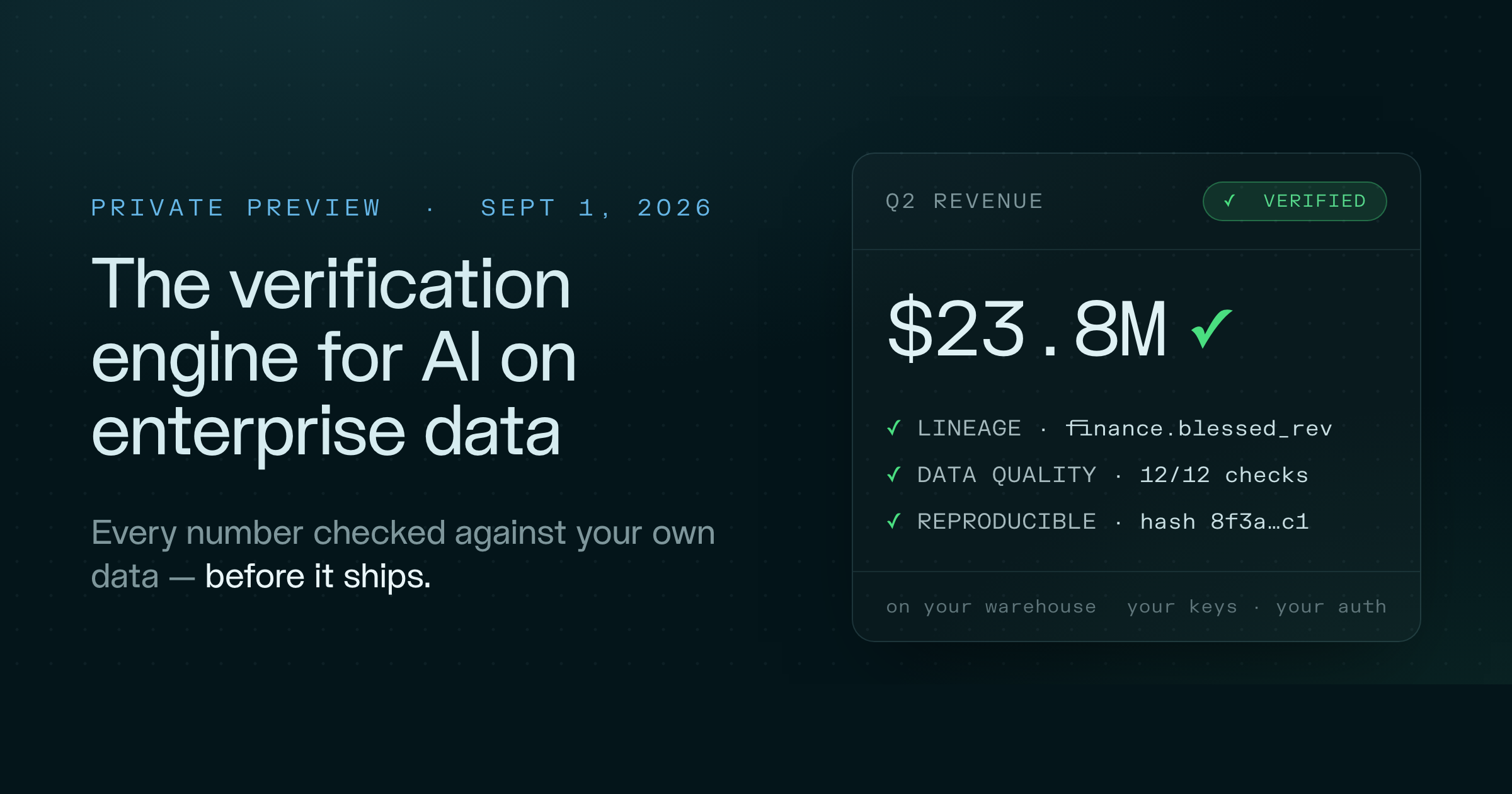
New York, NY — July 24, 2026 — Xorq Labs today announced that its verification engine for AI working on enterprise data enters private preview on September 1, 2026. The first way in is Xorq Desktop, a native client that lets a data team meet the engine on their own machine. The same engine also runs headless in their own cloud — so what a practitioner tries locally is the same verification a company deploys at scale.
Xorq checks the numbers an AI produces against a team’s own data, so a hallucinated value is caught and corrected before it reaches production — and every answer carries traceable lineage back to the sources the team already trusts. AI is now fluent enough to state a revenue figure or a risk exposure with total confidence. Whether that number is correct is a separate question — and in shift-left, regulated work, even a correct number no one can trace is a liability, not an insight.
“The engine is the product, and it runs wherever the work happens,” said Hussain Sultan, Founder & CEO of Xorq Labs. “Xorq Desktop is the easiest way to see it work: point it at your data, ask a question, and get an answer with a certificate and lineage behind it. The same verification then deploys headless in your own cloud, unchanged. The desktop is optional. The verification is not.”
The same verification, wherever the work happens
Xorq works with any model — open source, proprietary, or one from a major provider — and across any data engine (e.g. Snowflake, Databricks, +20), all on a team’s own warehouse, with no data migration:
- Xorq Desktop — a native client that runs local-first on a team’s own LLM subscription and warehouse credentials. Bulk data stays in the warehouse; only the aggregates a workflow needs reach an agent sandbox — no new vendor cloud in the data path, and a lighter security review.
- Xorq Headless — the same verification as a service in a customer’s own cloud, run as a subagent inside the agent harness a team already uses. Verified results return with a certificate and lineage, on the customer’s warehouse, keys, and auth. This is how large enterprises run Xorq at scale.
Underpinning it all is Xorq Memory, an open source executable semantic catalog: every expression stores its schema, SQL, and sources and is content-addressed, so agents compose new work only on expressions a human has blessed and reuse cached results instead of starting over. Results are cached and reused, so the warehouse never bills the same answer twice.
The proof, in benchmarks
On DABStep — a public benchmark of 450 questions over payment data — a smaller model paired with Xorq beats a larger model working alone. Anthropic’s Claude Haiku with Xorq Memory scores 84%, ahead of the 75% Claude Sonnet baseline, using the same model and prompt; only the verified work changes. Xorq also cut token usage by roughly 60%. Better answers at lower model spend.
Luke Pendergrass, Product Lead at Xorq Labs, will speak on making AI answers trustworthy enough to ship in the Startups & VCs track at Ai4 2026 in Las Vegas, August 2–5.
Open-source memory, no black box
Xorq Memory is open source, so teams can trace how every number is produced instead of trusting a black box. Xorq enters private preview on September 1, 2026 — first through Xorq Desktop for waitlist members and early subscribers, with headless enterprise deployments run alongside the Xorq team. Join the waitlist at xorq.dev, or explore the code at github.com/xorq-labs/xorq.
About Xorq Labs
Xorq Labs builds the verification engine for AI on enterprise data. Xorq checks the numbers an AI produces against a team’s own data, provides traceable lineage back to trusted sources, and caches results so the same work never runs twice — all on the team’s own keys and warehouse, with an open-source core. Xorq is backed by Lunar, Encoded, and Composed. Learn more at xorq.dev.